
Trevor Mulligan — twenty years a Rural Metro firefighter, Kolb and Sabino Canyon.
Hidden Valley Fire District Board · November 3, 2026
Trevor
Mulligan
20-year firefighter. 10-year neighbor.
I was a Rural Metro firefighter for more than twenty years — an engineer, the one driving the engine and running the pump on scene — most of it out of the station at Kolb and Sabino Canyon. Rural Metro is the company that answers your 911 call here in Hidden Valley. I know these crews, and I know what our district’s contract should ask of them. The board is signing a ten-year deal that asks for less and pays more. That’s why I’m running.
The contract
We pay 76% more for slower 911 response.
911 fire & medical response time
The national travel-time standard for the first engine on scene, met on 90% of calls.6
What our new ten-year contract asks for — and only on 80% of calls.1
What the district pays, FY2027 to FY2036: $476,880 rising to $838,832.4
Our 2010 agreement with Rural Metro promised a response no greater than seven minutes, on 80% of emergency calls.8
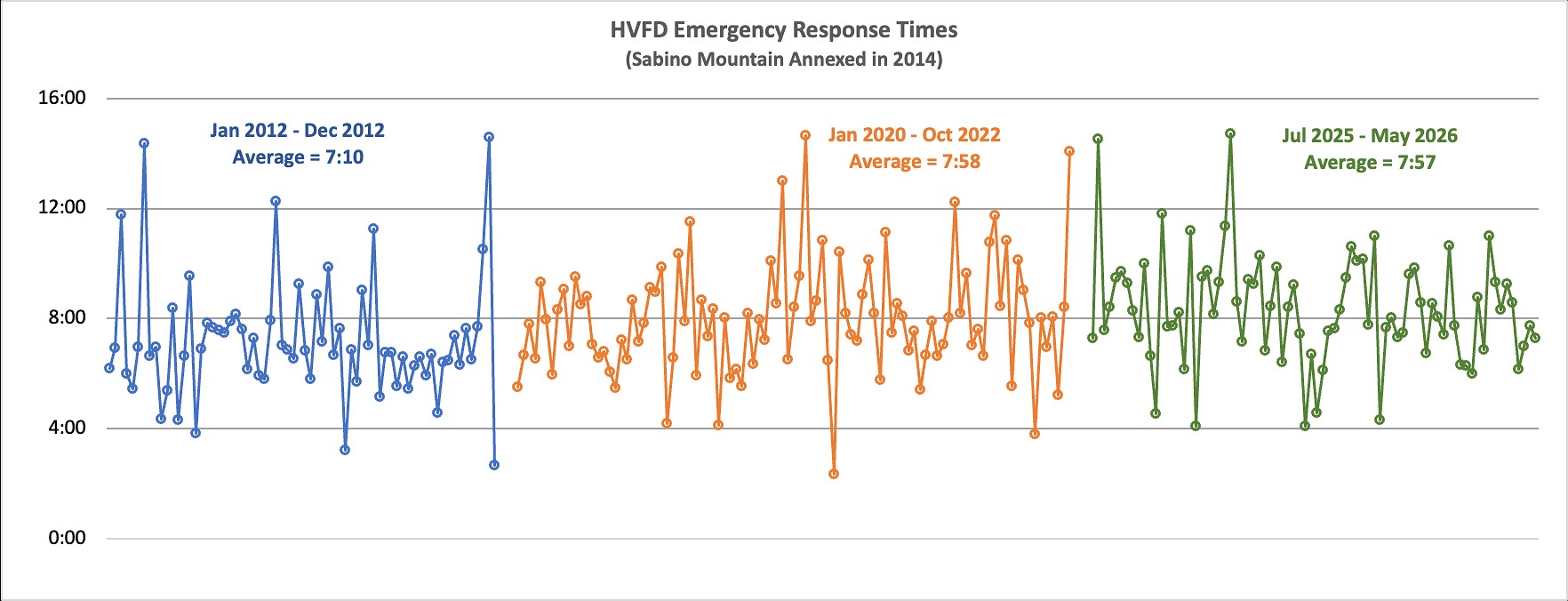
They did not meet it. Rural Metro’s own 2020 report to the district shows 21 of 81 calls ran over seven minutes — 71.08% compliance against a standard that required 80%.9 That report’s own footnote states the bar as 75%. It was missed either way.
Rural Metro’s compliance with the seven-minute standard in 2020, by its own count. The contract required 80%.9
The new ten-year agreement does not fix that. It moves the standard to 8 minutes 30 seconds — measured at the very same 80% threshold.1 The yardstick moved a minute and a half; the performance did not have to move at all.
Then it subtracts calls from the math. Responses are excluded when a call is downgraded, when Engine 73 is committed elsewhere or out of its primary area, during severe weather, during “unusual system overload,” and during any declared disaster — and Rural Metro may petition the district to drop individual calls on top of that.3
Meanwhile the fee schedule runs from $476,880 in FY2027 to $838,832 in FY2036 — a 75.9% increase over the ten-year term.4
And if Rural Metro misses the new, easier standard? Nothing happens. There is no penalty, no service credit and no rate adjustment anywhere in the agreement. The only exit is a five-year reopener in 2031, mediation, and then 365 days’ written notice — “without penalty to either party.”5
Performance reports do exist — monthly and annual, delivered to the district’s Board Chair.7 They are not published where you can read them. The district to our north, Golder Ranch, publishes a full Standards of Cover every year: 90th-percentile targets for every risk class and zone, four years of its own measured performance, and the call counts behind each number.1011
To be clear about what that comparison does and does not say: Golder Ranch is not necessarily faster than we are — their published 2024 suburban EMS figure is 10:45 at the 90th percentile.11 The difference is that they measure it, publish it, and can be held to it. We should expect at least that much.
Fix the performance, not the yardstick.
The documents
Don’t take my word for it.
Every number on this page comes from documents you can read. Both are here in full.
Every figure on this page is footnoted to a document, a section and a page — see the full source list.
About Trevor
Twenty years a firefighter. A decade up the road.
I was a Rural Metro firefighter for more than twenty years, most of it as an engineer — driving the engine and running the pump on scene, on the fire ground with the rest of the crew. Much of that out of the station at Kolb and Sabino Canyon, the house that covers our end of the foothills, with stints at other Rural Metro stations along the way. I have run calls on streets I could name with my eyes closed. I know what a response standard means when the tones drop at two in the morning, and I know what a crew can deliver when the contract actually asks for it.
My family and I have lived in Sabino Town & Country Estates for more than ten years. Our kids grew up here; the station I worked out of is the one that would come if we called. I got involved this summer the least glamorous way possible — I read the new contract at the kitchen table and emailed the board with questions. The answers made it clear nobody at that table had negotiated a fire service agreement before. I have sat on the other side of one. I’d rather sit on ours.
“I know these firefighters by name. I know exactly what they can do when the contract asks for it.”
— Trevor
Say hello if you see me out front. Knock if you don’t — I’d rather talk than mail you another flier.
The plan
Three things I’ll push for on day one.
-
A contract with teeth. Use the five-year reopener to add a service-credit clause: if the standard is missed, the district pays less.
-
Public numbers, every quarter. Post response-time performance against the standard on the district website, the way Golder Ranch does.
-
A board you can actually reach. Meetings at times working residents can attend, and agendas emailed to every household that asks.
Your ballot
How to vote for Trevor
Election Day is Tuesday, November 3, 2026.
Vote centers are open 6:00 a.m. to 7:00 p.m. The fire district board race is near the bottom of the ballot. Please don’t skip it — you can vote for more than one candidate in this race, so make one of them Trevor.
- Mon, Oct 5Last day to register to vote.
- Wed, Oct 7Early voting begins and early ballots are mailed.
- Fri, Oct 23Last day to request a mail ballot.
- Tue, Oct 27Recommended deadline to mail your ballot back. After this, use a drop box.
- Tue, Nov 3Election Day. Vote centers open 6 a.m.–7 p.m. Mailed ballots must be received, not postmarked, by 7 p.m.
All dates from the Pima County Recorder for the 2026 General Election.13
If you have a question about any of this, ask me directly — I answer my own email.
Sources
Every number, and where it comes from.
If a figure appears on this page, it is listed here with the document and section it came from. Two entries are marked “needs verification” — they are claims we have not yet attached a public document to, and they are marked that way until we can.
- 1. Response standard — 8:30 on 80% of calls. Agreement between Rural/Metro Fire Dept. Inc. and Hidden Valley Fire District (draft, effective July 1, 2026), §8 “Service Levels,” pp. 2–3: response times “shall be no greater than eight minutes and 30 seconds (8:30) in eighty percent (80%) of the time for emergency (Code-3) responses in each twelve (12) month contract period.” Open the agreement
- 2. What the clock measures. Same agreement, §1(a) “Definitions — Response Time,” p. 1: the time “begins when Pima County Communications notifies the fire station of an emergency call and ends with the arrival of unit(s) at the scene.” It does not include 911 call-taking or dispatch processing.
- 3. Calls excluded from the calculation. Same agreement, §9 “Performance Evaluation/Exceptions,” pp. 3–4: exclusions for downgraded responses, first-due unit (E73) unavailability, severe weather, “unusual system overload,” declared disasters, and a petition process for individual incidents.
- 4. Cost: $476,880 → $838,832, +75.9%. Same agreement, Appendix A “Fee Schedule,” p. 12: FY27 $476,880.00 through FY36 $838,832.00. The increase is 75.90%, rounded to 76% on this page.
- 5. Ten-year term, five-year reopener, no penalty. Same agreement, §11(a) “Term,” p. 5: ten years, July 1, 2026 to June 30, 2036, with a review at July 1, 2031, mediation, and termination on 365 days’ written notice “without penalty to either party.” The agreement contains no service-credit, liquidated-damages or rate-adjustment clause tied to response-time performance.
- 6. The 4:00 national standard. NFPA 1710, Standard for the Organization and Deployment of Fire Suppression Operations, Emergency Medical Operations, and Special Operations to the Public by Career Fire Departments: 240 seconds travel time for the first arriving engine company, achieved on 90% of incidents, plus an 80-second turnout time.
- 7. Reporting goes to the board, not the public. Same 2026 agreement, §10 “Reports,” p. 4: monthly staffing and call-activity reports and an annual performance analysis, provided to the Fire District’s Board Chair.
- 8. The previous seven-minute standard. Agreement between Rural/Metro and Hidden Valley Fire District, effective July 1, 2010, §8 “Service Levels”: response times “shall be no greater than seven (7) minutes in eighty percent (80%) of the time for emergency responses in each twelve (12) month contract period.” §11(a) sets the term at ten years, July 1, 2010 to June 30, 2020. The document is a scan; the quoted text is transcribed from it and can be read on the page linked here. Open the 2010 agreement
- 9. 71.08% compliance in 2020. “Hidden Valley Fire District 2020 — Rural Metro Responses,” Rural Metro’s own monthly/annual compliance report to the district: 81 total calls for the year, 21 exceptions over 7:00 (71.08% compliant) and 2 exceptions over 10:00 (98.15% compliant). The report’s footnote states the requirement as “<7:00 75% of the time, <10:00 100% of the time on emergency calls”; the 2010 agreement’s §8 text says 80%. 71.08% falls short of either figure. Open the 2020 report
- 10. Golder Ranch publishes benchmarks. Golder Ranch Fire District, 2025 Update: Community Risk Assessment — Standards of Cover, Figure 1.2 “New Benchmark Times”: alarm handling, turnout, travel and total response targets for every risk class and population-density zone. Open the report
- 11. Golder Ranch publishes its actual performance — including 10:45. Same report, Figure 1.3 “2024 Performance”: 90th-percentile baselines for 2021–2024 with call counts. Suburban low-risk EMS total response, 90th percentile, 2024: 0:10:45 (n=1,237).
- 12. The response-time chart. Chart of HVFD response times for Jan–Dec 2012 (avg 7:10), Jan 2020–Oct 2022 (avg 7:58) and Jul 2025–May 2026 (avg 7:57), noting Sabino Mountain was annexed in 2014. Published by the Hidden Valley Fire District on its own website. For the overlapping 2020 period it agrees with Rural Metro’s report above.9
- 13. 2026 General Election dates. Pima County Recorder: Oct 5 registration deadline; Oct 7 early voting begins and ballots mailed; Oct 23 last day to request a mail ballot; Oct 27 recommended mail-back date; Nov 3 Election Day, vote centers open 6 a.m.–7 p.m. recorder.pima.gov